Teaching for Wholeness™ · Educator Certification Pathway™

The evolution of the educator identity.

An educator's own transformation becomes the environment from which a student's true, fullest self emerges. The journey moves from the inside out: from the educator's own interior, to the classroom, to the institution, to the field, to the world.

See the four levels

The certification pathway

Four levels. Four identity shifts.

From role to awareness, awareness to embodiment, classroom to culture, school to paradigm: each level moves the educator further from implementing change to carrying it.

1
Role → Awareness

Wholeness Foundations Teacher

Understanding human inner development, recognizing nervous system dynamics in learning, seeing behavior as development rather than defiance. No longer operating unconsciously in the system.

"They see."

Inner Development + Emotional Intelligence

Understanding Humans

2
Awareness → Embodiment Prerequisite: Level 1, Wholeness Foundations Teacher, complete

Wholeness Classroom Practitioner

Creating regulation-first classrooms, building identity-safe environments, integrating emotional, cognitive, and relational development into teaching. Attuned authority instead of control.

"They teach from it."

Inner Development + Emotional Intelligence

Core Intelligences in Classroom Practice

3
Classroom → Culture Prerequisite: Level 2, Wholeness Classroom Practitioner, complete

Wholeness School Designer

Influencing school culture, aligning staff practices, designing systems for belonging and meaning, building parent-teacher developmental partnerships. Practitioner becomes architect.

"They design the system."

Inner Development + Emotional Intelligence
Applied and Future-Ready Intelligences

School and Community Design

4
School → Paradigm Prerequisite: Level 3, Wholeness School Designer, complete

Wholeness Ecosystem Leader

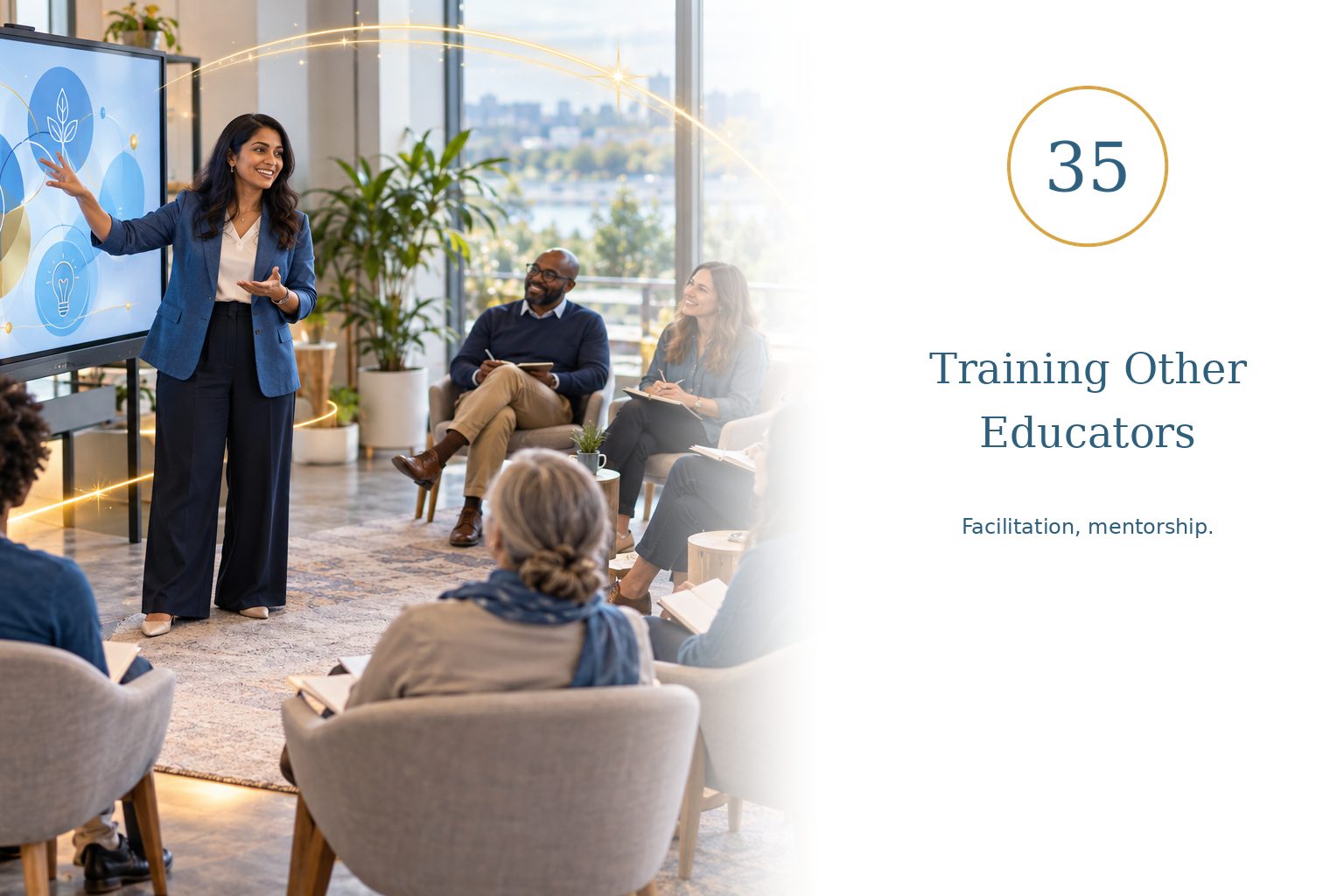
Leading transformation across schools, districts, and networks. Training other teachers, shaping policy and institutional direction, contributing to the emergence of the School of Wholeness.

"They carry the paradigm."

Inner Development + Emotional Intelligence
Advanced Human and Societal Intelligences

Systems Transformation

Before methods

The shift every teacher must internalize first.

This is the paradigm shift beneath every course, every level, every classroom practice.

Delivering content→Developing humans
Classroom management→Nervous system & relational safety
Academic success→Whole-human capacity
Standardization→Developmental personalization
Authority→Attuned leadership
Information→Integration

Level 1 · The conscious teacher journey

Not therapy. Not content consumption. Transformation.

Six emotional stages carry every teacher through Level 1: professional clarity and human understanding, not personal exposure.

Stage 1 · Relief

"It's not just me."

Validation and normalization. Teachers feel seen, less alone, less like they're failing.

Stage 2 · Recognition

"My students make sense now."

A developmental lens replaces frustration with compassion. "Why are they like this?" becomes "Of course they are."

Stage 3 · Disruption

"I've been operating inside this system too."

Discomfort and pattern recognition. Teachers notice their own triggers, control habits, and inherited beliefs. The turning point.

Stage 4 · Self-awareness

"I see my role differently now."

Reflection and ownership. Teachers recognize what they bring into the classroom, and where they react versus respond.

Stage 5 · Responsibility

"I can't unknow this now."

Agency replaces blame. Teachers begin asking: what kind of teacher do I want to be?

Stage 6 · Hope

"There is a way forward."

Grounded in understanding, not motivation. Teachers see what can change, how, and that they're not alone.

The three lanes of knowing

An epistemological framework for the classroom.

How to teach meditation without turning it into spiritual instruction. How to honor a student's sense of purpose without imposing a worldview. This is the framework that makes it possible.

Lane 1 · Science

The regulated nervous system

Neuroscience of learning and safety in the classroom. What the evidence shows about what actually produces engagement, retention, and meaningful growth.

Lane 2 · Practice

Feeling the relational field

Personal regulation practices before, during, and after class. Attention training: learning to feel the room, and to influence it intentionally.

Lane 3 · Meaning-making

Why did I enter this field?

What does education actually mean to me, beneath the institutional pressures? Is my practice aligned with what I want a student to carry forward?